There is no churchgoing revival in England and Wales
David Voas
4 March 2026
Background
The Bible Society’s Quiet Revival report claims that the Christian church in England and Wales is in a period of rapid growth and that young adults are more spiritually engaged than any other living generation.
The report makes a number of startling claims, based on polls conducted by YouGov in 2018 and 2024. To pick out four of the key ones:
Total churchgoing has gone up by more than half since 2018
Anglican attendance has increased by 30% since 2018
Catholic attendance has more than doubled since 2018
Young men’s attendance has increased five-fold since 2018
And also:
Men are now more likely than women to be churchgoers
In the 18-34 age group, men are nearly twice as likely as women to be churchgoers
More than one in five young men are churchgoers
Close to half of young Black people aged 18–34 are now attending church at least monthly
There’s a degree of circularity in the stories of revival, with articles based on the Quiet Revival (QR) report being cited and re-cited. The claims in the QR report are not supported by data from the churches themselves or from high-quality surveys based on random (probability) samples.
My key criticisms of the report first appeared in June 2025:
Is there really a religious revival in England? Why I’m sceptical of a new report
See also the January 2026 comment piece for The Telegraph, reproduced here as Appendix 1.
No, there is no Christian revival in the West
Church attendance counts
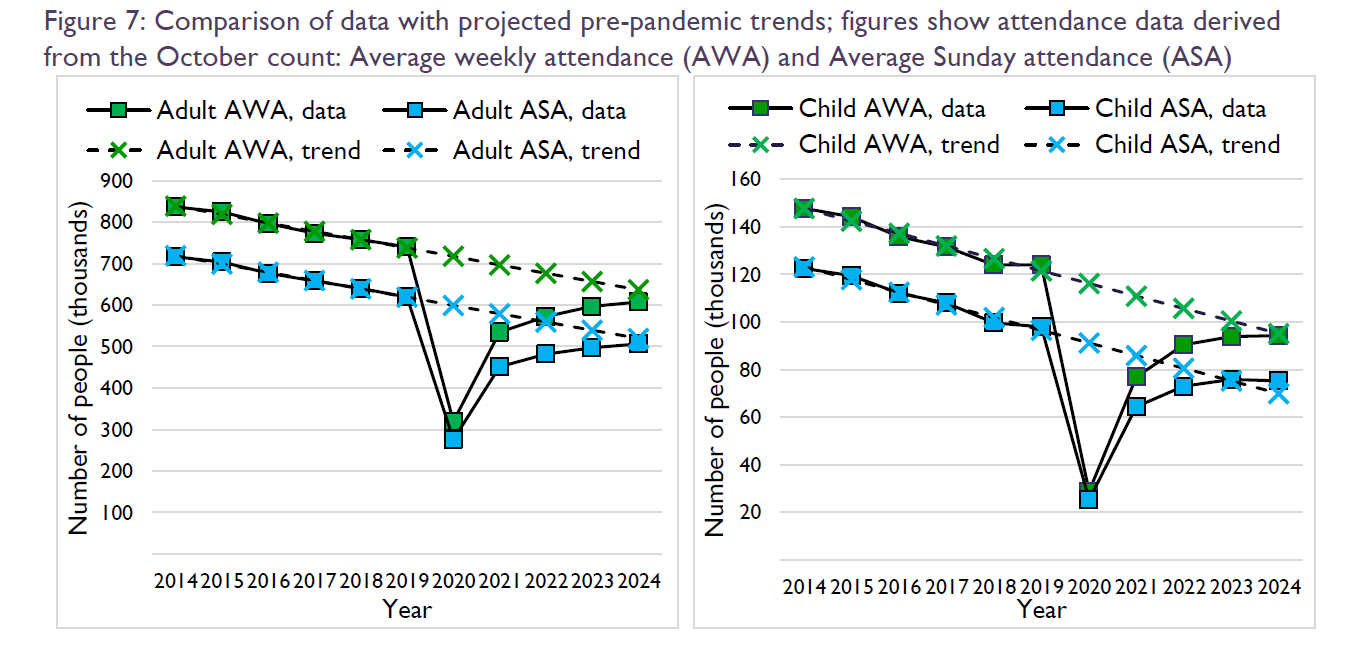
The revival story is contradicted by the attendance statistics published by churches themselves. We have good data from the two largest denominations in England and Wales – the Church of England and the Catholic Church – and more partial data from the Methodist and Baptist churches. All show that attendance has dropped from the pre-pandemic level by roughly 20%; the exact amount depends on what is being measured.
The QR report asserts that “Whereas in 2018 Anglicans made up 41% of churchgoers, this has dropped to 34% in 2024” (QR, page 18). But as total churchgoing supposedly increased from 3.7 million to 5.8 million (QR, page 6), the implication is that regular attendance in the Church of England went from 1,517,000 to 1,972,00, an increase of 30%. In fact, the Church of England reports something entirely different in its annual review published in 2025: “As the Statistics for Mission figures clearly demonstrate, by almost every measure, in almost every diocese, Church of England attendance and participation was still significantly lower in 2024 than in 2018.”
Ken Eames, Senior Statistical Researcher for the Church of England, adds “It would be naive to believe that the Statistics for Mission figures are accurate to the nearest person; however, I am confident that the national totals and trends calculated from the Statistics for Mission dataset are broadly accurate. I base that confidence on the high response rate, consistent methodology applied year on year, detailed church-by-church data checking, and consistency of results across variables and across dioceses.” (Statistics for Mission 2024, page 20).
https://www.churchofengland.org/sites/default/files/2025-10/statisticsformission2024.pdf
The C of E report shows graphs of adult and child attendance counts compared to an extrapolation of the pre-pandemic trends (in dashes). The description in the text is as follows: “Figure 7 shows recent October attendance data alongside projected pre-pandemic trends. These trends are not telling us what would have happened if there had not been a pandemic; instead, they show what would had happened if the pre-pandemic trends (from 2014 to 2019) had continued. Adult attendance in 2024 was below its 2019 levels, and remained below the projected pre-pandemic trend. Child attendance in 2024 was close to or above the projected pre-pandemic trend.” (Statistics for Mission 2024, page 14).
The Bible Society asserts that the revival is mostly happening outside the Church of England, so we could decide not to worry about the C of E statistics. Because the Church of England is such a large part of the religious landscape, however, growth would need to be enormous elsewhere to boost churchgoing by more than half in the absence of large Anglican increases.
It is no surprise, then, that the Bible Society claims that “Catholicism has risen sharply.” According to their figures, Catholics were 23% of churchgoers in 2018 and 31% in 2024. As total churchgoing supposedly increased by 56% over that period, from 3.7 million to 5.8 million, the implication is that Catholic mass attendance has more than doubled.
We know from the Catholic church itself, however, that the reality is far different. The Catholic Bishops’ Conference of England and Wales counted 701,902 people attending Sunday mass in 2019. In 2024, there were 575,453 – a drop of 18%.
Perhaps independent and Pentecostal churches are going great guns below the radar. If the Bible Society is right, we are looking for millions of new churchgoers. They would have to be very quiet indeed – not to say invisible – to have escaped our notice.
Today even evangelical and charismatic churches, which have until recently been growing, are showing signs of decline, with the only really growth mostly linked to immigration. Even the Baptist Union lost half its membership between 1970 and 2020.
In short, we can be confident that churchgoing is lower now than it was in 2018. Attendance was of course suppressed during the Covid lock-downs, and it has slowly rebounded in the past few years, but it remains substantially lower than before the pandemic. We can confirm this reality by looking at high quality social surveys.
The British Social Attitudes survey
Gold standard social surveys are based on random (probability) samples of the population: everyone has a chance to be included. The British Social Attitudes survey is one such example; it is widely regarded as the most reliable source of data on these issues. By contrast, people opt in to YouGov’s survey panel and are rewarded after completing a certain number of surveys. The risk of low-quality or even bogus responses is considerable. (The issues with opt-in online polls are discussed below.)
As a reminder, the Bible Society reports an increase in the Christian churchgoing share of the population from 8% to 12% between 2018 and 2024. The British Social Attitudes (BSA) survey suggests that the first figure is too low and the second is too high. The BSA shows the values reversed: a decline from 12.2% in 2018 to 8.7% in 2024.
There has been no jump in young men’s attendance.
Sir John Curtice wrote a briefing note on this issue, published by NatCen just before Christmas:
Is there a religious revival in Britain? | National Centre for Social Research
The key measure used by the Bible Society is the percentage of the adult population of England and Wales who say that they are Christian and attend church monthly or more often. The graph below shows the complete run of those values from the British Social Attitudes survey, 1983-2024 (omitting the pandemic years of 2020 and 2021):
Christian churchgoers, England and Wales (as a percentage of the adult population)
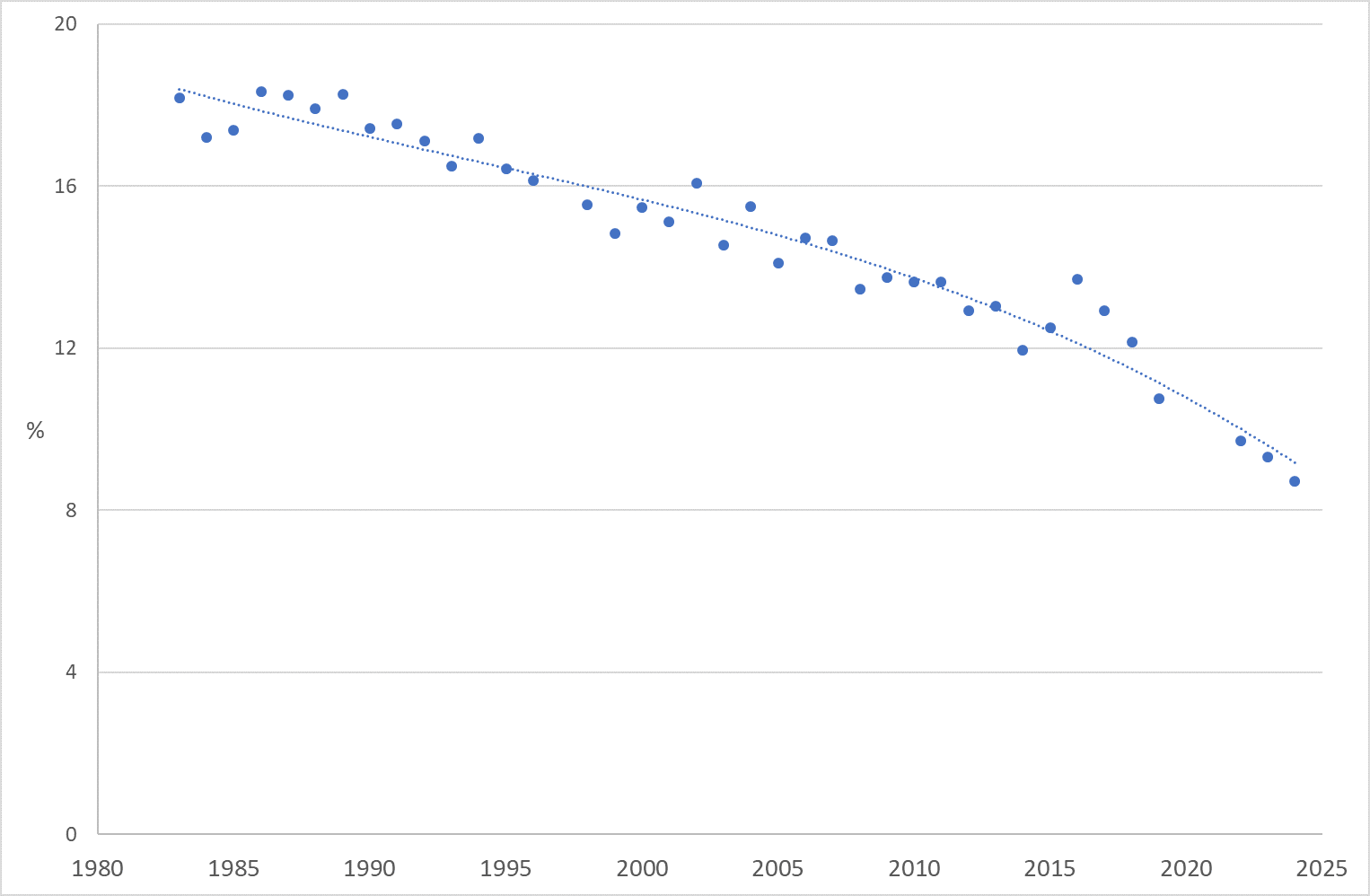
Far from seeing a revival, we find a slight acceleration of decline after the Covid pandemic.
The Labour Force Survey and the Community Life Survey
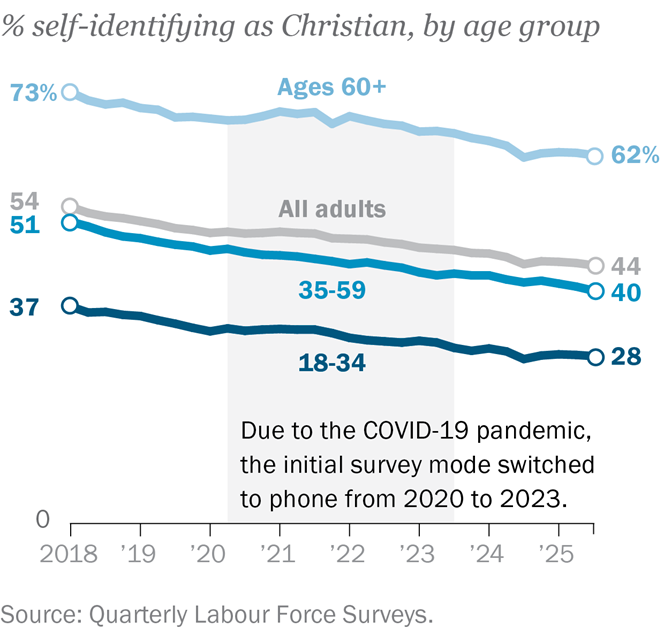
There is also evidence from high-quality official surveys with very large samples. Analysis of the Labour Force Survey by the Pew Research Center shows Christian identity in Britain continuing to decline across all age groups.
In mid-February 2026, the dataset from the latest round of the Community Life Survey (one of the largest government surveys) was released. Summary tables on religious practice by age are provided in Appendix 2.
There is a period in late adolescence and emerging adulthood when young people are still closely connected to their families of origin; teenagers (here, the 16-19 age group) are always a little more religious than young adults. Even in their early 20s, many young adults are working out what they believe, how to identify themselves, and whether to go to church. Nevertheless, the Community Life Survey shows the 20-24 group having the lowest level of religious practice, with men being less practising than women at all ages (contrary to the claims in the QR report).
The World Values Survey
Some proponents of the Christian revival narrative concede that young people are not calling themselves Christian or even going to church. They argue that the revival is in spiritual or religious interest and belief. The evidence also contradicts this weaker version of the story.
The people who were born just before and after the millennium are now emerging into independent adult existence. The evidence from the World Values Survey (WVS) in the UK, conducted in 2022, is that this ‘Gen Z’ is the least religious generation (again contrary to the QR claims). They are less likely to believe in God, and less likely to feel that God is important in their lives, than older people.
We know from the WVS that Gen Z has the lowest levels of belief in God (37%) of any generation (though relatively high belief in life after death, at 51%).
Notwithstanding the discourse about their supposed openness to spiritual exploration, 31% of Gen Z consider themselves to be atheists – the highest of any cohort.
In answer to the question “Independently of whether you attend religious services or not, would you say you are a religious person?”, only 27% of Gen Z say ‘yes’, lower than any other generation.
In responding to the question “How important is God in your life, on a scale from 1 to 10, where 1 is not at all important and 10 is very important?”, close to two thirds of Gen Z chose 1, 2 or 3. Again, Gen Z stands out as the least religious generation.
The British Election Study Internet Panel and the YouGov tracker poll
The Bible Society continues to insist that we should have confidence in their YouGov polls. But as I wrote last year, the revival narrative is contradicted not only by high-quality surveys based on random samples of the population: “The findings are also inconsistent with other data from YouGov, the polling firm that collected the data for the Bible Society. A decade ago, the British Election Study (BES) commissioned YouGov to create an online panel. This panel, which includes more people than the Bible Society surveys, was asked about religious affiliation and church attendance in 2015, 2022 and 2024. According to YouGov’s data for the BES internet panel, the share of Christian churchgoers in England and Wales declined from 8.0% to 6.6% between 2015 and 2024, whereas YouGov’s surveys for the Bible Society apparently show an increase from 8% to 12% between 2018 and 2024.”
The findings are obviously contradictory. YouGov is in an awkward position; they cannot disavow their high-profile work for the British Election Study, but it would be embarrassing to admit that their work for the Bible Society is flawed. The kindest verdict is that opt-in online panels are unreliable when it comes to measuring trends in church attendance.
An even more astonishing example is the YouGov tracker poll. One of the variables they follow over time is belief in God.
For the 18-24 age group, the numbers go from 19% in mid-2022 up to 45% in early 2025, and then come back down the roller coaster to 27% a year later. It is implausible that belief in God would follow that sort of trajectory in such a short period. And given that this poll was frequently cited in support of the revival narrative, we have two choices: we can either say that the Quiet Revival has evaporated, or that it was a mirage in the first place.
Problems with opt-in online polls
YouGov creates a quota sample from their large self-selected panel. The sample will match the population on a number of key characteristics, such as age and sex, but that does not make it representative in all respects. As quota samples do not give each person in the population a known chance of being selected, statistical inference is not possible and findings cannot be reliably generalised. In particular, one cannot calculate margins of error or confidence intervals.
To write (as in the QR report) that because thousands of people participated in the two surveys, they “give a 1% margin of error at a 99% confidence level” is misleading. One can only make such statements for random samples (with any non-response also occurring at random). With opt-in surveys, it makes little difference whether there are ten respondents or ten thousand; we have no way of knowing what the margin of error might be.
This study is not the first time such non-probability sampling has led to dubious findings. In late 2023, the Economist ran the story that one in five young Americans believed that the Holocaust was a myth, based on another YouGov poll. A study by the Pew Research Center showed that that finding was almost certainly fallacious, and the Economist added a disclaimer acknowledging the problem.
Conrad Hackett, senior demographer at the Pew Research Center, provides a more complete discussion of the problem here:
Why surveys showing Christian revival in Britain may be misleading | Pew Research Center
The proliferation of low-cost opt-in online surveys is parasitic on the reputation of high-quality survey research. Correspondence with Conrad Hackett on the apparent religious bias of opt-in polls can be found in Appendix 3.
The anecdotal revival
Faced with the overwhelming volume and quality of objective evidence showing that churchgoing continues to decline, proponents of the revival story resort to subjective reports of growing churches and young people showing an interest in spirituality. But there are tens of thousands of churches in England and Wales. There are churches that are growing and churches that are closing. The question is not whether one can find growth in Christianity in Britain but rather whether that is the overall direction of change.
The Church of England Statistics for Mission 2024 report states that “in approximately 12% of churches the usual Sunday attendance, average Sunday attendance, and average weekly attendance were all higher in 2024 than in 2019; in approximately 48% of churches the usual Sunday attendance, average Sunday attendance, and average weekly attendance were all lower in 2024 than in 2019” (page 20). The Church would ideally identify some common factor (theological tradition, worship style, activities, clergy characteristics, or whatever) associated with church growth and consider whether it can be scaled up. Despite much research over many years, it has never been able to do that, so we just see random eddies of growth in a sea of decline.
The explanation is probably what Reginald Bibby called “the circulation of the saints.” C of E parishes are so small even in rural areas that it is easy to choose which church to attend out of half a dozen nearby. Unless you are strongly committed to your own parish, you will go to the one that has the most charismatic leader, the biggest congregation, the best Sunday school for children, or whatever. When the minister moves on or something changes, you might shift your allegiance. It is not possible to have growth in the majority of churches because at the individual level there are more people leaving or dying than joining.
Turning from churches to individuals, there is again no difficulty in finding examples of religious growth. There are roughly 50 million adults in England and Wales; thousands of them show more interest in religion than they did the year before, just as thousands more drift less visibly in the opposite direction. The quantity of anecdotes to support the revival narrative is limitless.
Church leaders are in the good news business, ‘good news’ being the root meaning of both gospel and evangelism. If more young people are attending, we will see it at a local level, and if it were to be replicated very generally, then it would show up in the statistics. It does not. We use high quality, probability-based scientific surveys precisely because the alternative is to generalize from our own experiences, which are often atypical.
At this point, no one is being quiet about any signs of revival. What continues with little notice is the magnitude of quiet quitting. Every year, thousands of emerging adults who were raised as churchgoing Christians drift away without fanfare. The return of a few thousand adults over a couple of years is completely dwarfed by the much less visible defection of tens of thousands of adults every year for decades.
Similar stories of youth-led revival in other countries have likewise been debunked. In the United States, the Pew Research Center (the leading resource for unbiased analysis) found that “Recent polling shows no clear evidence of a religious revival among young adults”; even Ross Douthat, a religious conservative writing for The New York Times, has declared that “No, young men are not returning to church.”